A handrail is the one part of a stair people actually hold, usually when they are carrying something or when they slip. That is why the code is specific about its height, its shape and how it ends. This guide covers the residential rules in the IRC and clears up a few points that are often repeated wrongly.
Section numbers and some dimensions change between code editions, and many cities amend them. Use this as a checklist of what to confirm with your building department.
Handrail or guard?
They are different things with different rules:
- A handrail is something to grip while climbing. Height and shape matter.
- A guard is a barrier that stops a fall from an open edge. Height and openings matter. The IRC requirements guide covers guards.
A stair side can need both, and a single railing can serve as both only if it meets both sets of rules.
When you need one
A handrail is required on at least one side of every flight with four or more risers. A stair with three risers or fewer does not need one under the model code, although many builders add one anyway.
Height
The top of the handrail must be 34 in to 38 in above the nosings, measured vertically from the sloped line that runs along the front edge of the treads. Fittings used for a smooth transition, such as a turn or the start of a flight, may go above 38 in.
Shape: something you can wrap your hand around
- Round: 1¼ in to 2 in in diameter.
- Not round: a perimeter of 4 in to 6¼ in, with the widest part no more than 2¼ in.
- Larger profiles (perimeter over 6¼ in) need a finger recess on both sides so the hand can still grip.
A 2×4 laid flat on top of posts does not qualify: its perimeter is too large and it has no grip.
Clearance
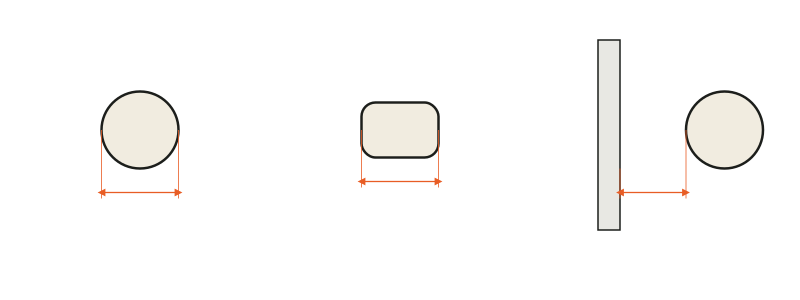
- Between the handrail and the wall: at least 1½ in, so a hand fits behind it.
- Projection into the stair: a handrail may not project more than 4½ in into the width of the stairway. That is why the stair width minimum is 36 in but the usable clear width can be as little as 31½ in with a handrail on one side.
Continuous, and how it ends
- Continuous. The handrail must run the full length of the flight, from a point directly above the top riser to a point directly above the bottom riser, without a break that makes you let go.
- Ends. Each end must return to the wall, finish in a newel post, or use a safety terminal. The goal is that a sleeve or a bag cannot catch on a rail that just stops.
- Allowed interruptions. The rail may be interrupted by a newel post at a turn, and a decorative start such as a volute or a turnout is allowed over the lowest tread.
What the code does not say
You will read in many places that a handrail must extend 12 in beyond the top and one tread depth beyond the bottom. That rule comes from accessibility standards and commercial codes. The sources reviewed for this guide do not show a required extension past the top riser in the residential model code, but some cities add one, so check locally before you assume either way.
Common mistakes
- Rail too high or too low because it was measured from the floor instead of from the nosings.
- A rail that stops in mid-air with no return or terminal.
- Brackets that interrupt the grip, forcing a hand to let go at each post.
- Too little space behind the rail where it runs along a wall.
- No handrail at all on a flight of four or more risers.
Plan it with the stair
Handrail height depends on the nosing line, which in turn depends on the riser and tread. The stair calculator gives you the pitch angle, so you can set the rail parallel to it.
Sources and further reading
- Spokane County: residential handrails and guards
- MyBuildingPermit: handrails tip sheet
- City of Lake Stevens: handrail guidelines
- Town of Edisto Beach: handrail grip size (2021)
- Knox County codes: residential stair requirements
Try it with your own numbers.
The stair calculator checks your rise and tread against the IRC, shows the stair in 3D and prints a dimensioned plan.
This guide is general information, not engineering or legal advice. Building codes differ by location and edition, so confirm the rules with your local building department before you build.